Why We Built Yesflow: Engineering Discipline as a Business Advantage

On the surface, the problem looked simple.


Our teams needed a task management system that supported engineering workflows, rich technical discussions, and accountability.

But once we stepped back, it became clear the real problem was not features. It was control.

The SaaS Trap

  • Your operational data lives outside your infrastructure
  • Your workflow history becomes someone else’s asset
  • Compliance posture depends on third-party assurances
  • Costs scale linearly with headcount
  • Customization stops where the vendor roadmap stops

For a company working with government authorities, regulated enterprises, and sensitive programs, these are not acceptable trade-offs.

So instead of asking “Which SaaS should we buy?”
We asked “What should an internal system look like if we take data sovereignty seriously?”

Yesflow was the answer.

Data Sovereignty Is Not a Checkbox. It’s an Architectural Choice.

At YS Tech, data sovereignty is not a marketing phrase. It is a design constraint.

That single constraint immediately ruled out entire classes of tools.

With Yesflow:

  • All data lives inside our infrastructure
  • No external APIs are required for core functionality
  • No third-party storage, indexing, or analytics
  • No hidden data flows or opaque processing

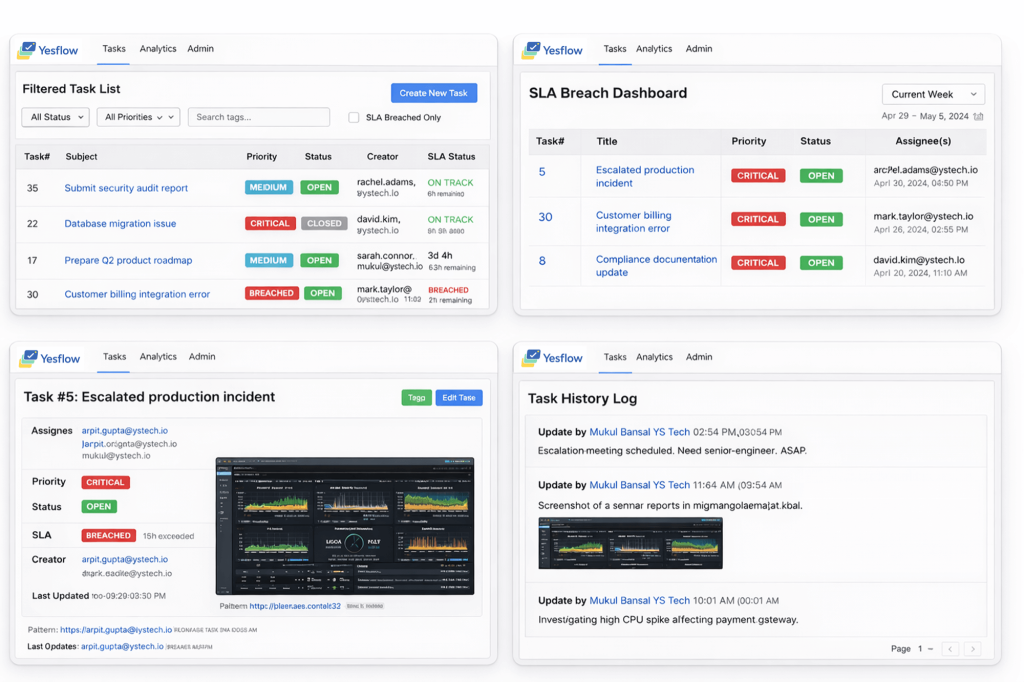
Every task, update, SLA breach, comment, and attachment is stored in in-house databases, auditable at any time.

This matters for compliance, but it matters even more for organizational confidence.
When leadership asks, “Where is our data?”, the answer is simple and provable.

Engineering Choices That Enable Business Outcomes

Yesflow is intentionally boring in the best way.

It is built on technologies and patterns that enterprises understand, trust, and can operate for years.

Clean, Predictable Backend Architecture

  • Spring Boot with strict layering
  • DTO-first design to prevent accidental data exposure
  • Explicit transaction boundaries
  • Query patterns optimized for scale, not demos
  • Indexing is designed around real usage, not assumptions

These are not academic decisions.
They are what allow the system to remain stable as usage grows, teams change, and requirements evolve.

Rich Collaboration Without SaaS Dependencies

Engineering teams don’t just assign tasks. They discuss, debate, attach context, and leave trails.

Yesflow supports that without outsourcing capability to external platforms:

  • Rich text editing for technical discussions
  • Inline images and screenshots
  • Code blocks and structured formatting
  • User mentions that drive accountability
  • Full HTML emails that preserve context

All of this works without relying on third-party editors, storage providers, or content pipelines.

SLA Tracking as an Operational Signal, Not a Dashboard Widget

One of the most valuable outcomes of Yesflow has been visibility.

SLAs are not vanity metrics. They are signals about process health.

Yesflow tracks SLA deadlines automatically based on priority, flags breaches in real time, and produces weekly summaries without manual intervention.

This does two things:

  1. Teams get clarity on what truly matters
  2. Leadership gets an honest view of delivery reality

No dashboards gamed by selective reporting.
No hidden failures buried in chat threads.

Just facts.

Cost Control Is a Strategic Capability

Per-user SaaS pricing looks harmless until your organization scales.

Yesflow has zero licensing cost.
Not “cheap”. Zero.

That changes how teams behave:

  • No friction in onboarding users
  • No hesitation in expanding usage
  • No budgeting debates for basic tooling
  • No feature gating tied to plan tiers

For YS Tech, this is not about saving a few invoices.
It’s about removing cognitive overhead from engineering and operations.

Internal Tools Reflect Organizational Maturity

There’s an uncomfortable truth in engineering organizations:

The quality of your internal tools reflects the seriousness of your engineering culture.


Yesflow is not built to impress outsiders.
It is built to serve our teams reliably every day.

That mindset carries over into client work:

  • Predictable architectures
  • Clear ownership boundaries
  • Long-term maintainability
  • Audit-friendly systems
  • No dependency surprises

Clients don’t see Yesflow directly, but they feel its influence in how we design, document, and deliver systems.

Why This Matters to Our Clients

Yesflow reflects the same principles we apply across all client systems at YS Tech: data sovereignty, control, and architectural transparency.

Organizations today are increasingly wary of blind SaaS adoption, unclear data residency, long-term licensing exposure, and deep vendor lock-in. These risks directly impact compliance, governance, and operational continuity.

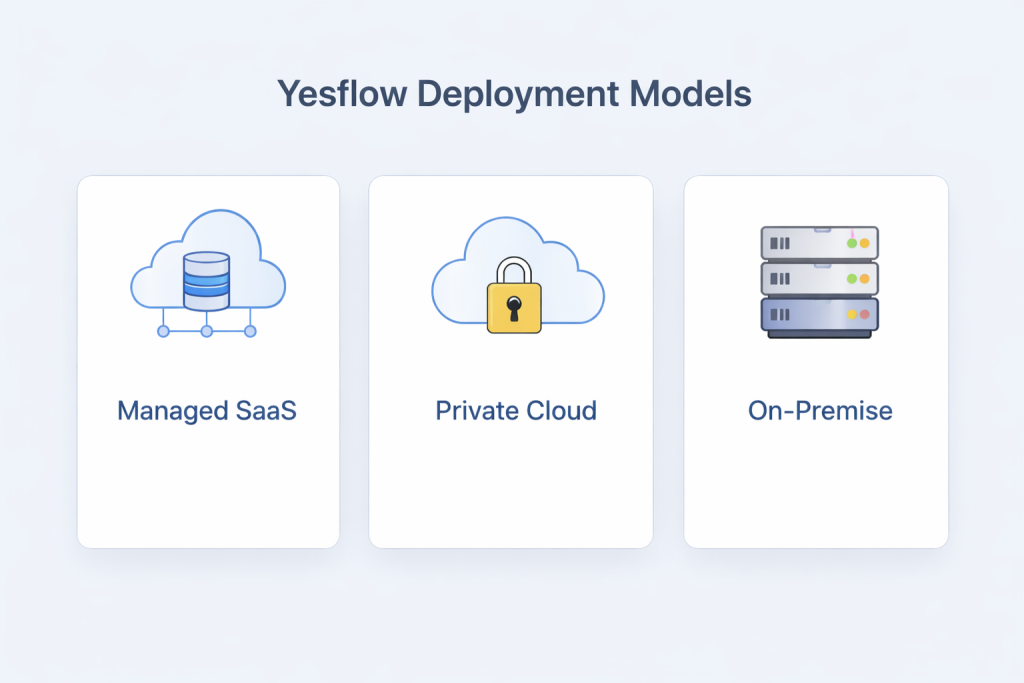
By building and operating Yesflow ourselves, we demonstrate how enterprise-grade platforms can be delivered without compromising data ownership. The same system we use internally can be deployed for our clients as a managed SaaS, private cloud, or fully on-premise solution — depending on regulatory and operational needs.

For our clients, this means their data stays where it belongs, under their control, with no opaque dependencies or forced trade-offs.

Conclusion

Yesflow is not “just a task management tool”.

It is a quiet assertion that:

  • Ownership matters
  • Engineering discipline compounds over time
  • Data sovereignty is a competitive advantage
  • Internal systems deserve the same rigor as client systems

At YS Tech, we build the kind of software we want to depend on for the next decade.

Yesflow is one example of that philosophy in action.

Ready to Simplify, Scale, and Empower Your Workforce?