

At YS Tech, engineering choices are guided by three principles: data sovereignty, cost efficiency, and developer experience. For years, Postman served as our default tool for API testing and documentation. But as our team scaled past 100 developers, its rising licensing costs and dependence on third-party cloud storage increasingly conflicted with our philosophy.
This is the story of how we migrated our entire engineering org from Postman to Bruno, built a Git-native synchronization framework around it, and achieved complete control over our API testing workflows — with zero friction for developers.
Why We Moved Away From Postman
Postman is powerful, but its cloud-based architecture introduces two major concerns for large engineering teams:
1. Escalating Licensing Costs
With over 100 developers, annual Postman fees had become substantial. As our API landscape grew, the cost only increased.
2. Lack of Data Sovereignty
Postman collections, test suites, and documentation lived on Postman’s cloud.
For a company handling government, fintech, and public-facing infrastructure projects, this was unacceptable.
We needed:
- A fully self-hosted workflow
- A Git-native way of storing API artifacts
- Zero per-user licensing
- First-class developer experience
Why Bruno?
Bruno stood out immediately:
- Completely free & open-source
- Git-native filesystem format for collections
- Local-first architecture
- Fast, lightweight, and developer-friendly
- No vendor lock-in
Bruno solved the sovereignty problem, but its local-file structure required us to engineer something Postman handled implicitly: multi-user synchronization at scale.
So we built it.
Designing a Git-Based, Auto-Sync Infrastructure
To make Bruno usable at scale, we created a cross-platform auto-sync system that transparently keeps every developer’s local Bruno collections in sync with a Git repository.
High-Level Architecture
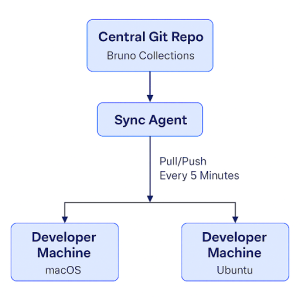
Each developer machine runs a background sync service.
How Sync Works
Each client machine runs a lightweight background process that:
- Auto-commits local changes (if any)
- Rebases with upstream to maintain a clean, conflict-free history
- Pulls latest collections every 5 minutes
- Pushes local updates when needed
- Ensures zero developer interaction required
This gives us:
- Deterministic updates
- Freedom from merge conflicts
- A pristine Git audit trail
- Near real-time sync across 100+ developers
Platform-Specific Implementation
macOS — LaunchAgent-Based Service
- A LaunchAgent triggers sync every 5 minutes
- Runs automatically at startup
- Silent, resilient, and resource-light
Ubuntu — Cron-Based Service
- Cron schedules sync jobs
- Works universally across Linux setups
- Zero dependencies beyond Git
Developers install the sync agent with a single command.
Results: Control, Savings, Transparency
1. Massive Cost Savings
By replacing Postman licensing across 100+ developers, we eliminated recurring costs and redirected those funds into internal tooling and R&D.
2. True Data Sovereignty
All collections now live entirely inside YS Tech’s Git infrastructure:
- No cloud dependency
- Fully auditable history
- Automatic backup via Git
- Zero external access to API data
3. Seamless Developer Experience
Our developers experienced no workflow disruption:
- Collections always stay up to date
- No manual sync required
- Familiar Git-based workflow
- Identical behavior on macOS & Ubuntu
This migration proved something important: data sovereignty does not have to come at the cost of developer experience.
A Step Towards Full Data Independence
Moving to Bruno is part of a broader initiative at YS Tech:
- Replace proprietary SaaS tools with open-source alternatives
- Run critical systems entirely on our own infrastructure
- Build internal tooling where needed
- Future-proof our development workflows
This migration was one of the most meaningful steps in that direction.
Open-Sourcing Our Solution
We’re now preparing to open-source:
- Our cross-platform auto-sync engine
- Installers for macOS & Ubuntu
- Documentation, architecture, and hardening guides
- CI/CD templates for Git-based Bruno workflows
We believe that data sovereignty should be accessible to every engineering team, not just those with large budgets.
Open-sourcing this will help companies worldwide adopt Bruno at scale with confidence.
Final Thoughts
Migrating 100+ developers from Postman to Bruno wasn’t just a tooling change — it aligned our workflows with our core values: ownership, efficiency, and engineering excellence. With the auto-sync ecosystem we engineered, Bruno now fits seamlessly into our organization.
And soon, it will be available for everyone.
Have questions about our migration or want to adopt a similar setup? Reach out at [email protected]